


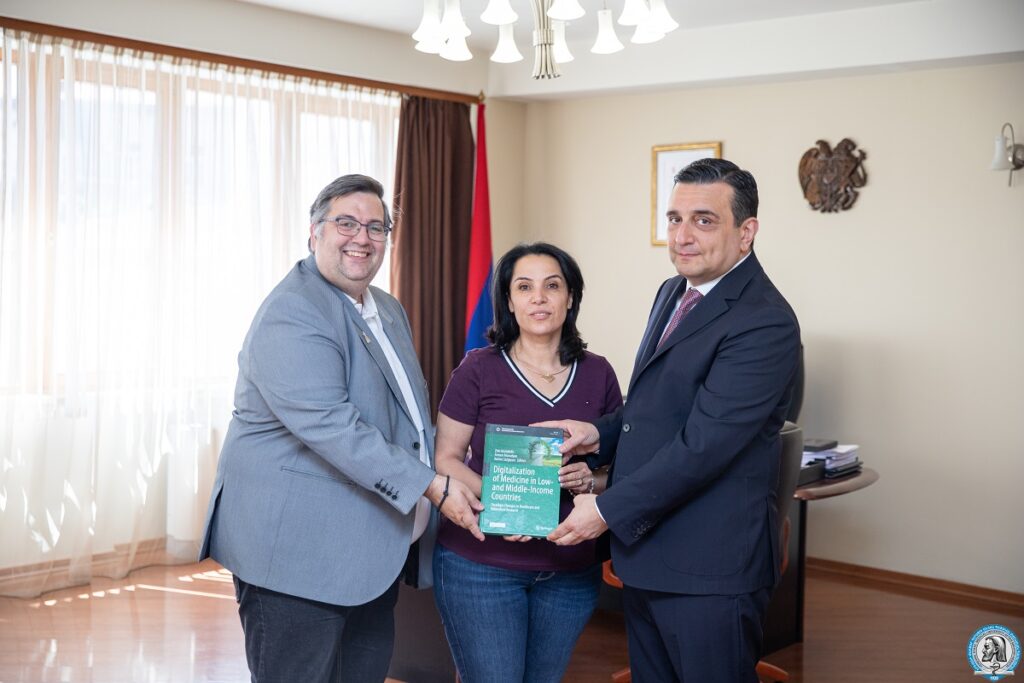
A meeting was held at Yerevan State Medical University after Mkhitar Heratsi between Rector, Professor Armen Muradyan, YSMU Honorary Professor, Head of the Department of Digital Medicine and Artificial Intelligence, Director of the Oncology Biobanking Research Program at Cedars-Sinai Medical Center in California, USA, Karine Sargsyan, and Head of the Laboratory Services and Biobanking Group of the International Agency for Research on Cancer (IARC), Zisis Kozlakidis.
Also present at the meeting were Vice-Rector for Academic Affairs Larisa Avetisyan, Vice-Rector for Scientific Affairs Konstantin Yenkoyan, and Vice-Rector for Development and Marketing Khachatur Margaryan.
It is worth noting that in 2024, the book “Digitalization of Medicine in Low- and Middle-Income Countries” was published in Switzerland, co-authored by Armen Muradyan, Karine Sargsyan, and Zisis Kozlakidis.
This open-access handbook outlines why the digitalization of medical services is essential and what level of digitalization is possible in low- and middle-income countries.
By establishing a solid foundation of current trends and future perspectives in digital health, the book enables readers to gain a comprehensive understanding of how digital healthcare is being adapted to different contexts in low- and middle-income countries, contributing to the creation of impactful success stories.
It is noteworthy that shortly after its release, the book became a bestseller at the world-renowned Springer Nature International publishing house.
Most recently, Professor Karine Sargsyan, who heads the Department of Digital Medicine and Artificial Intelligence at the university, was unanimously elected Chair of the Scientific Advisory Board of the Center for Molecular Fingerprinting (CMF) — an institution led by a Nobel Prize nominee in the field of molecular diagnostics.
According to her, the university’s departments of Digital Medicine and Artificial Intelligence and Medical Genetics are preparing to create digital and molecular twins through in silico modeling, which will contribute to the improvement of diagnosis and prognosis of non-communicable diseases. “No other country in the region is carrying out such large-scale work in this direction of medical science. On a national scale, this implies a personalized approach to all diseases. For example, in the field of oncology, internationally accepted treatment protocols are applied in our country, but with a personalized approach using digital and molecular twins, treatment effectiveness can increase by 50%,” emphasized Karine Sargsyan.
According to the professor, this work will continue in cooperation with the Departments of Pathology and Radiological Diagnostics to improve the quality of digital and clinical diagnosis.
“Thanks to the enrichment and development of digital and molecular twins, we will have the opportunity for early diagnosis, which will contribute to more accurate and effective treatment,” Karine Sargsyan highlighted, adding that all efforts will continue within the framework of the newly established department to implement other major projects aimed at advancing medical science in Armenia.