


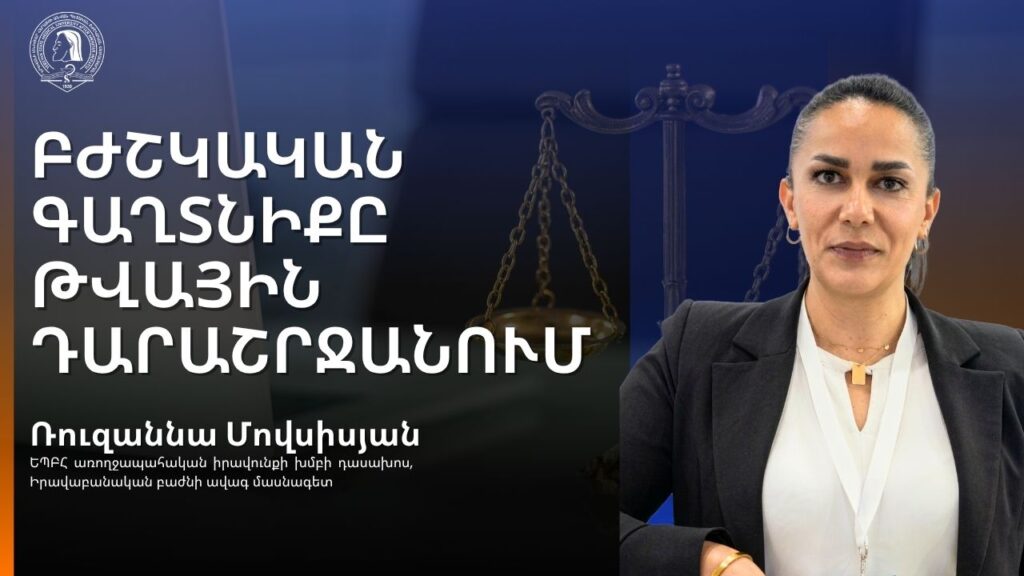
The rapid development of digital healthcare has created new opportunities while also raising important questions about medical confidentiality, personal data protection, and patients’ rights.
To discuss these and other pressing issues, we spoke with Ruzanna Movsisyan, Lecturer at the YSMU Healthcare Group and Senior Specialist at the Legal Department, about the legal and ethical challenges of protecting medical confidentiality in Armenia’s digital healthcare system.
Digital healthcare is one of the greatest achievements of modern medicine, and I am truly inspired by the potential of these systems to enhance the quality of patient care. The goal of my research is not to offer criticism, but to support the system by identifying areas where legal and security-based solutions can make the work of medical professionals even more effective.
We are at a natural stage of development. Today, technology is evolving faster than the legal framework, which is typical during periods of digital transformation. This is the historical moment when we can refine our legislation, making it more flexible and better aligned with international best practices.
The GDPR serves as the gold standard of international practice for us. Our goal is not merely to replicate it, but to adopt its most effective tools, particularly the Privacy by Design approach. This will allow us to build a more integrated and reliable system for the benefit of both patients and physicians.
A centralized model offers immense opportunities for diagnostics and epidemiological analysis. The challenge lies not in the structure itself, but in strengthening its security layers. Modern digital tools enable us to protect centralized data while maintaining accessibility whenever it is needed.
The workload in medical institutions is significant, and sometimes certain security details may be overlooked due to sheer busyness. This is not negligence; rather, it highlights the need to establish a new workplace culture. We must create conditions where complying with security requirements becomes an easy and automatic part of everyday practice.
Physicians instinctively seek the fastest ways to communicate in order to help their patients. This reflects their dedication to their profession. What we need is to move this communication into the secure environment of electronic healthcare systems by providing healthcare professionals with more convenient and secure tools.
Our healthcare professionals are highly qualified specialists. However, legal aspects often remain in the background because of heavy workloads. By placing greater emphasis on training, we can provide them with additional protection and greater confidence in their daily work. Legal awareness is an essential component of ensuring the safe performance of professional responsibilities.
Trust is built through transparency. The questions raised by patients are entirely natural. Our goal is to demonstrate that the digital healthcare system is designed, first and foremost, to protect their rights.
Transparency is the key to trust. It would be ideal to have a system that enables patients to see how their treatment journey is being improved with the support of their physicians. This is not about surveillance—it is about participatory healthcare.
A Data Protection Officer (DPO) will serve not as an auditor, but as a facilitator. They will work alongside physicians, helping them navigate complex legal issues so that healthcare professionals can focus entirely on patient care. This role will become an essential pillar of the strategic development of healthcare institutions.
This represents a new horizon—one that reflects respect for patient autonomy. It will enable us to build physician-patient relationships based on mutual trust and clear agreements, ultimately improving the quality and effectiveness of healthcare.
Our objective should be to resolve such issues through systemic improvements rather than litigation. Strengthening existing mechanisms will enable disagreements to be addressed promptly, effectively, and at a professional level.
What is the single most urgent step the Armenian government should take to ensure that digital healthcare is not only effective but also genuinely secure?
The most urgent step is to deepen public and professional dialogue. We must continue constructive cooperation among the government, healthcare professionals, and society so that digital healthcare becomes a source of national pride for Armenia through its safety, security, and high quality.