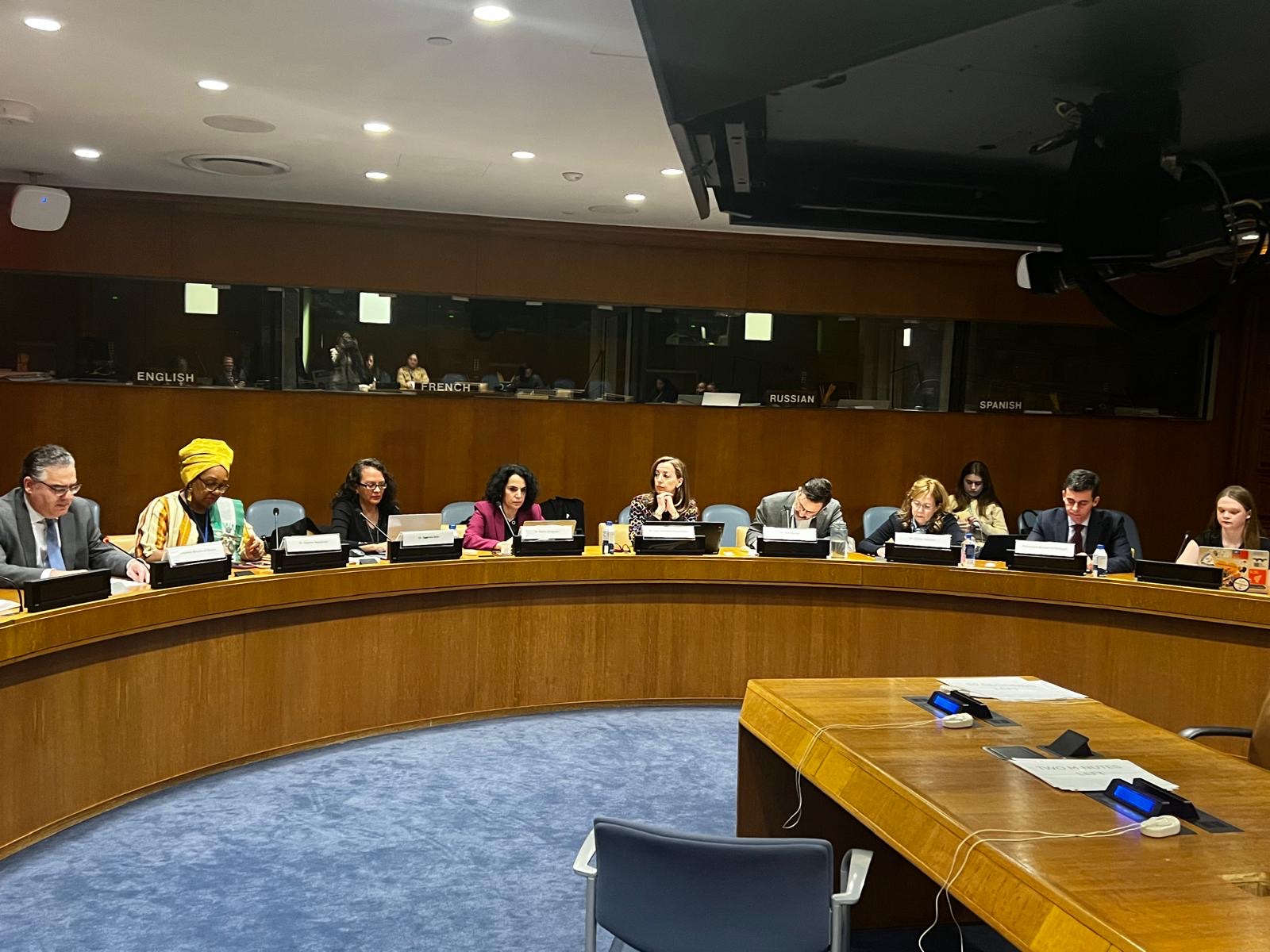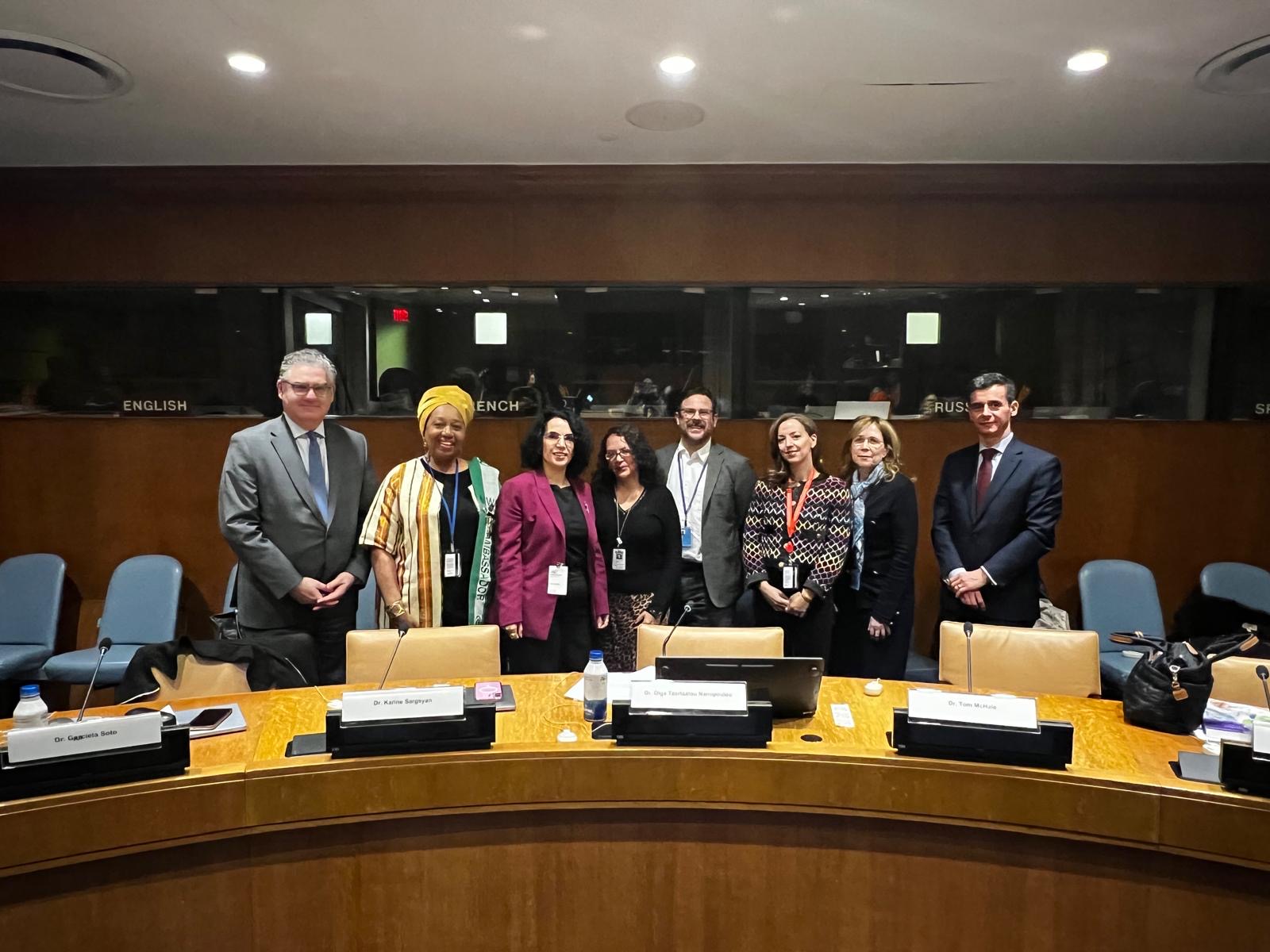
Karine Sargsyan, Honorary Professor of Yerevan State Medical University after Mkhitar Heratsi, Director of Operations of the Institute of Inflammatory Bowel Diseases (IBD), and Scientific Director of Oncobiobanking at Cedars-Sinai Medical University in California, USA; Founding Director of the Biobank at the University of Graz in Austria; spoke at the session of the UN Economic and Social Council.
During the panel discussion titled “Justice in the Digital Age: Advancing Women’s Right to Health in Low Literacy and Digitally Excluded Contexts” the Armenian scientist was presented by Dr. Olga Tzortzatou Nanopoulo, the co-founder and CEO of “Nanopoulos Foundation” which is committed to bridging the gap between digital health innovation and community understanding. “Karine Sargsyan is one of the most compelling scientific voices working at the intersection of innovation and equity today. And we are truly privileged to have her as the opening voice of this panel, and as a guiding presence throughout our conversation. Her expertise uniquely positions her to speak to a question that is too often overlooked: “Who is and who is not represented in the data that shapes our most advanced medical technologies?” She is someone whose work does not simply advance science, it asks science to be accountable to the people it is meant to serve”, the Greek specialist emphasized.
In precision medicine and oncology digital tools and data driven research are advancing very rapidly. How can we ensure that women are adequately represented in the data that informs these innovations?
In response to the question, Professor Sargsyan noted that three years ago, doing a research for a book that we wrote about digitization of medicine in low- and middle-income countries, we have realized that AI-driven tools in precision medicine and oncology rely on training data from clinical trials, registries, and real-world evidence. “And when these sources already underrepresent women relative to men, althpugh the disease burden is the same or even higher,
the resulting models reflect just historical imbalances rather than biological reality. So, potentially this leads to suboptimal performance for female patients. Recent analyses confirm ongoing gaps: In the most important trials supporting modern cancer therapies approved by the FDA (as of 2024), women comprised only 40.7% of participants (24,538 women versus 35,678 men), despite the fact that in some subtypes, women were affected at comparable or higher rates. In cardiovascular trials (2017–2024, >1.39 million participants), women made up approximately 41% overall, with even lower proportions in key areas such as coronary heart disease and heart failure. The UK MHRA’s submissions (2019–2023) show that 90% of trials were designed to include both sexes, but only 3.7% of trials included women, compared to 6.1% of trials included men. In recently approved breast cancer trials, black women were represented at only 0.6%, despite the fact that black women have a 40% higher breast cancer mortality rate than white women”, Karine Sargsyan noted.
These imbalances, she said, also extend to AI applications: models based on male data may underestimate cardiovascular risk in women (due to differences in symptom presentation), provide less accurate dosing recommendations (from skewed pharmacokinetic studies in men), or show reduced diagnostic performance of chest imaging in women. “The digital divide further exacerbates this. As of 2025, the global gender parity score for internet use remains at 0.92 (unchanged since 2019), with approximately 235-320 million fewer women using mobile internet than men in low- and middle-income countries, and a total of 885 million women in South Asia and sub-Saharan Africa disproportionately lacking internet access,” she stressed.
To fill this evidence gap in a systematic way, she proposed:
These steps, according to Karine Sargsyan, can help AI reflect the comprehensive biology of humans, rather than perpetuating selective historical patterns.
What role can translational medicine play in bridging the gap between leading biomedical innovation and equal access to healthcare for women?
Translational medicine, Karine Sargsyan mentioned, serves as a critical bridge from scientific discovery to clinical application, but the timeline of innovation shows uneven progress across different fields. “The Da Vinci Surgical System received FDA clearance for general laparoscopic procedures in 2000, with an early focus on urological applications (e.g., radical prostatectomy), followed by specific gynecological clearance in 2005 for procedures such as hysterectomy and myomectomy, but is used in only 39% of cases. This platform has since enabled minimally invasive approaches with documented benefits in terms of reduced blood loss, shorter hospital stays, and faster recovery for many gynecological conditions”, the Professor noted. In contrast, Karine Sargsyan believes that basic gynecological care tools have undergone limited development. “The bifurcated vaginal speculum, perfected in the mid-19th century (e.g., the Cusco design ~1870, Graves iteration), retains its basic form despite persistent reports of patient discomfort during pelvic examinations, Pap smears, and minor procedures. Instruments like the tenaculum date back to the late 1800s. While recent proposals explore patient-centered redesigns (e.g., multi-blade or ergonomic alternatives), widespread adoption remains slow compared to advances in sophisticated robotic systems. This discrepancy illustrates how translational pathways can prioritize the most sophisticated innovations (often first validated in male-dominated fields), while fundamental tools for women’s everyday health are evolving more gradually”, Karine Sargsyan observed. Globally, she said, access gaps are widening in digitally excluded and low-literacy contexts, disproportionately affecting women. “Translational medicine can help fill these gaps by: